US Expands Military Presence Around Iran Amidst Strategic Questions
Washington has deployed a third aircraft carrier to the Middle East, raising concerns about the sustainability of the conflict as munitions stocks and naval morale face strain.
By Amir Bennett ·
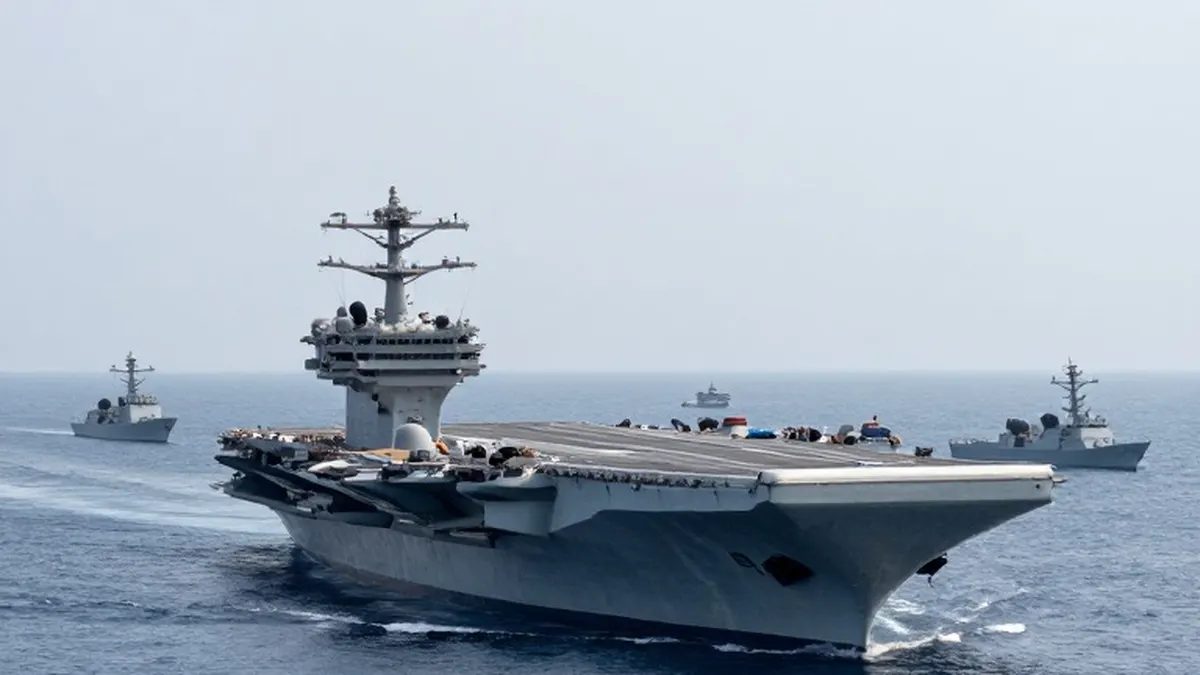
The United States has intensified its military footprint in the Middle East, with a third aircraft carrier and its escort vessels arriving in the region on Sunday. This deployment of the USS Theodore Roosevelt carrier strike group occurs while Washington maintains that it does not intend to resume large-scale combat operations. Instead, the administration aims to continue pressuring Iran through an economic blockade that has been in effect since July 14.
Secretary of State Marco Rubio stated on November 10 that military strikes were unnecessary if economic pressure could achieve the same objectives. However, the growing military presence suggests that the blockade may not quickly force Tehran into capitulation. Recent attacks in the Gulf have demonstrated Iran’s willingness and capacity to respond to perceived threats from the United States.
Logistical challenges are emerging within the US Navy, which is reportedly nearing a breaking point. Navy Secretary Hung Cao informed sailors and their families to prepare for deployments lasting at least 11 months, a significant increase from the standard six-month period. These extended tours are draining morale, with growing resentment among rank and file sailors over the prospect of another open-ended war. The Navy has deployed at least 17 destroyers to enforce the blockade, a notable portion of its total fleet of 77, with nearly 30 currently undergoing maintenance.
Analysts argue that the administration is in a difficult position, attempting to use military strength to force a diplomatic deal. Omer Ozkizilcik, a senior fellow at the Atlantic Council, noted that while the US can achieve tactical victories, these do not compensate for strategic errors. He highlighted that a major miscalculation was placing greater trust in Israeli intelligence than in US advisers, leading to the belief that a short air campaign would be sufficient to force Iran’s surrender.
In addition to the sea blockade, Washington has established a land campaign known as Task Force Iron Gate to control Iran’s land crossings. President Trump declared this force fully effective on November 8, claiming the war was effectively over militarily. However, skepticism remains regarding the durability of the current status quo, with many analysts suggesting that renewed fighting would likely yield similar results to previous engagements.
The economic toll of the conflict has spread globally. The German Chancellor noted that higher energy costs have cost European businesses and consumers over $112 billion. In the United States, Moody’s estimated the war added approximately $2,000 to the average household’s costs, while Brown University’s tracker reported that American consumers paid more than $161 billion in additional energy bills. The impact has also been felt in Asia and Africa, with significant increases in fossil fuel costs and lost economic output.
Munitions shortages present another hurdle. The Wall Street Journal reported that the Pentagon is struggling to secure critical materials for Patriot missile interceptors due to supply chain issues. A report by the International Institute for Strategic Studies warned that US stocks remain depleted, having expended two-thirds of pre-war inventory. The Center for Strategic and International Studies estimated that US forces used between 1,060 and 1,430 Patriot interceptors during the previous campaign, representing a substantial portion of their total stockpile.
Hamidreza Azizi, an Iran analyst at Crisis Group, emphasized that while the US has the capability to inflict damage, this does not guarantee a political settlement. He warned that without a credible diplomatic exit strategy, renewed military action risks prolonging the conflict. The central dilemma for Washington is that it can threaten Iran with force, but may lack the strategy to compel Tehran to accept its terms on its own timeline.
The Gulf states, which face the highest risk from renewed fighting, are currently focused on diplomatic maneuvering. Qatar continues to seek mediation, though analysts note that their room for action is limited primarily to influencing the Trump administration. As the military build-up continues, the tension between projecting strength and managing resource constraints defines the current landscape of the US-Iran confrontation.