Potatoes emerge as viable crop for future lunar agriculture
A new study led by Oregon State University demonstrates that potatoes can thrive in simulated lunar soil when supplemented with organic compost, offering a potential food source for permanent moon bases.
By Youssef Carter ·
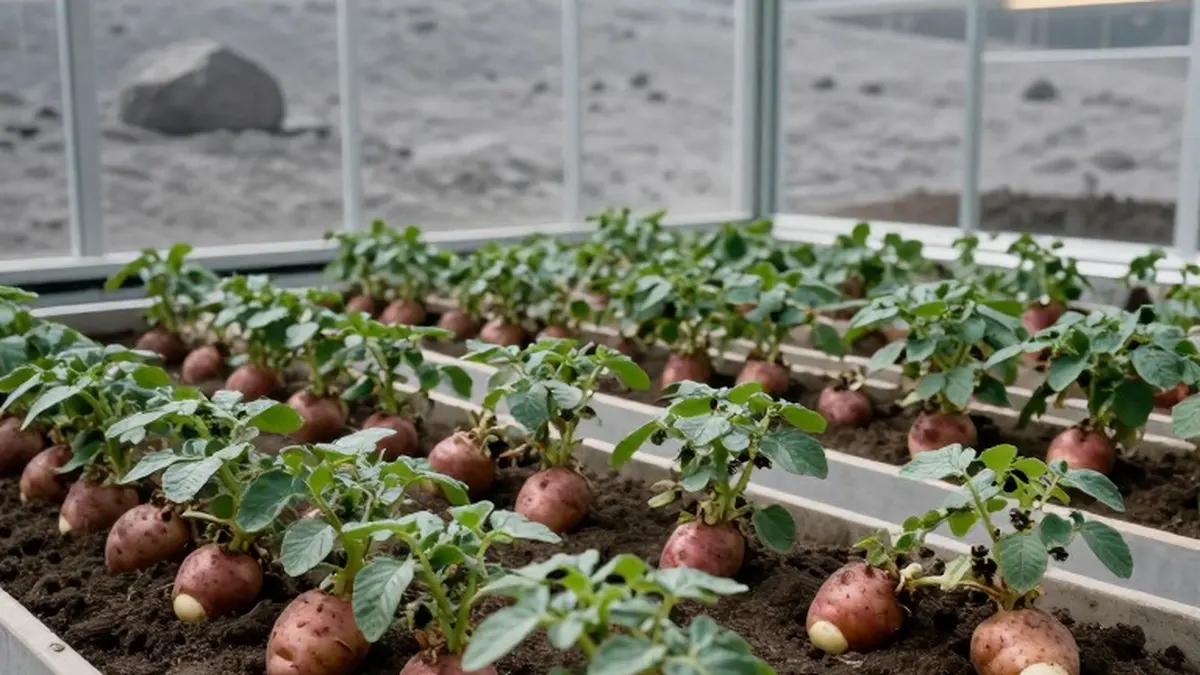
A new scientific report suggests that the potato could play a central role in sustaining human life on the moon. The study, conducted by researchers backed by the US space agency Nasa, indicates that long-term lunar exploration will rely on life support systems capable of producing food directly on the lunar surface. The team concluded that potatoes are an ideal candidate for this purpose after successfully growing them in simulated lunar soil.
The findings were published in the journal npj Microgravity under the title “Growth and molecular responses of potato to lunar regolith simulants.” Regolith refers to the layer of loose stones and dust that covers the solid rock found on the moon, Mars, asteroids, and parts of Earth. Aymeric Goyer, a plant biologist at Oregon State University who led the study, highlighted the nutritional advantages of the crop. He noted that potatoes provide more calories per land area than many other plants, contain more potassium than bananas, are rich in vitamin C, offer good protein content, and have a high satiety index.
The experiment utilized lunar regolith simulants, which are engineered Earth-based materials designed to replicate the properties of moon dust and soil. To support plant growth, the researchers added varying levels of vermicompost, an organic soil amendment created when composting worms break down organic waste. The specific potato variety used in the trial was the Modoc cultivar, an early-maturing type with reddish skin and white flesh.
Goyer explained that native lunar regolith lacks nitrogen, meaning no crop can grow without supplementation. In their initial tests, potatoes planted in lunar material without vermicompost produced almost no roots or tubers. However, when as little as 5 percent vermicompost was added, the plants developed some roots and tubers. At a 30 percent concentration of vermicompost, the yield was identical to that of potatoes grown in standard Earth soil under the same conditions.
The researchers emphasized the importance of ensuring the food produced is edible, as the experiment envisions future lunar greenhouses. Goyer acknowledged that the sample potatoes used for the primary lab analyses were grown in small pots and weighed less than a third of an ounce. While these small samples were not tasted, a separate study using larger pots yielded potatoes of a size typically found in stores, which the team confirmed were viable for consumption.
The timing of this report coincides with announcements from both the US and China regarding plans to establish long-term bases near the lunar south pole. Nasa aims to return astronauts to the moon by 2028, while China targets a similar milestone before 2030. Such permanent bases will likely require local food production, as supplying all nutritional needs from Earth may not be sustainable.
A key challenge identified in the study is the heavy metal content of lunar regolith, which is hostile to crops. Goyer stated that without organic matter, potatoes absorb excessive amounts of these metals, which can become toxic. Organic matter helps reduce the availability of heavy metals to the plants, preventing over-accumulation and ensuring the crop remains safe.
This research builds on previous studies, including a 2017 report from the International Potato Center in Peru that showed potatoes could sprout in conditions mimicking Mars. Earlier this year, Nasa astronaut Don Pettit demonstrated growing a purple potato named “Spudnik” on the International Space Station. Pettit noted that in microgravity, roots often grow upwards toward moisture, a phenomenon he linked to the movie The Martian.
While potatoes are a leading contender, other crops such as chickpeas, tomatoes, lettuce, and legumes like alfalfa are also being studied for lunar agriculture. David Handy, a space biologist at Oregon State University and co-author of the study, suggested that technologies developed for lunar farming could also benefit life on Earth. He explained that these methods could improve soil quality and aid in remediation for regions with low agricultural output, such as inner cities and desert communities.
The study highlights a dual benefit for space exploration and terrestrial agriculture. By understanding how to cultivate crops in harsh, nutrient-poor environments, scientists can develop sustainable techniques that improve food production in challenging conditions on Earth. This ongoing research underscores the potential for self-sufficient ecosystems in space and on our own planet.