Harvard Analysis: Moon Water Supports 10,000, Not 1 Million
A new study calculates that lunar water reserves may only sustain a small settlement for centuries, challenging executive promises of rapid, large-scale colonization.
By Amir Bennett ·
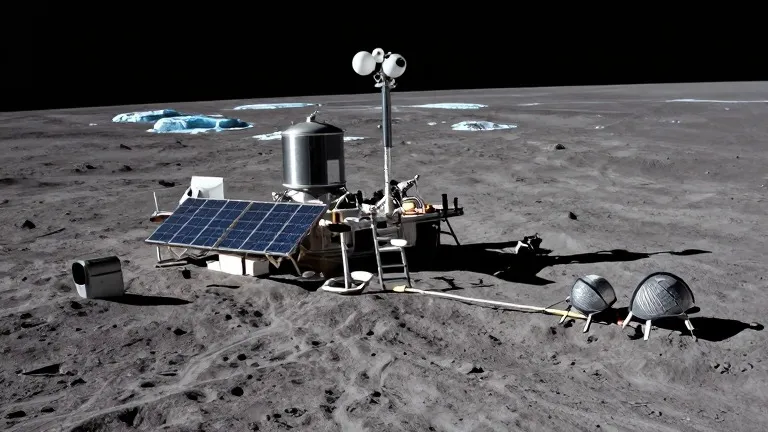
A new analysis published in Frontiers in Space Technologies indicates that the Moon's available water may only support a population of 10,000 for centuries, rather than a million residents for a century. The study, led by Martin Elvis of Harvard University and Jonathan McDowell of Durham University, tests the feasibility of large-scale lunar habitation against current estimates of essential resources.
The research responds to recent public statements by major space companies. In February, SpaceX CEO Elon Musk stated that his company is building a self-growing city on the Moon, a goal he estimates could be achieved in under ten years. Blue Origin CEO Jeff Bezos has similarly predicted that millions of people will live in space by 2045. Elvis and McDowell examined whether the lunar environment can physically support such densities.
The researchers determined that power generation is not a limiting factor. Solar and nuclear sources would be sufficient to sustain one million people. The constraint is water. Most lunar water is believed to exist in permanently shadowed polar regions. Using an estimate of one billion tonnes of total water, the study found that one million people could survive for only 100 years, provided they recycle 98 percent of their water, a rate consistent with current operations on the International Space Station.
Elvis described the total volume as modest, comparing it to an aquarium the size of Central Park filled until the Statue of Liberty was submerged. He noted that such a volume is insufficient for a major city. For a smaller settlement of 10,000 people, the same water supply would last for centuries. McDowell added that if the goal is to cover the Moon with cities as depicted in science fiction, new methods for transporting water are required because the existing supply is limited.
The authors suggest the one-billion-tonne estimate may be too high. Elvis stated that the figure is likely 20 to 30 times larger than the actual recoverable amount. He estimates that only about one percent of the water is accessible, which would reduce the lifespan for one million residents from 100 years to one year. Gordon Osinski, a planetary geology professor at Western University, added that satellite data has uncertainties. He suggested the water may exist as sub-millimetre ice crystals mixed into soil, similar to Arctic permafrost, making extraction difficult.
McDowell emphasized that the findings are factual rather than discouraging. He stated that the truth is never negative, but attempting a project that is not feasible is. The study provides a baseline for planning future infrastructure, indicating that water management will be the primary bottleneck for lunar expansion.