Afghan Borderlands Become New Opium Hub After Taliban Ban
Satellite data reveals over 9,000 hectares of poppy fields in Pakistan and Iran as production shifts from Afghanistan.
By Amir Bennett ·
The world's largest opium supplier is losing its crown, but the drug is not disappearing; it is moving.
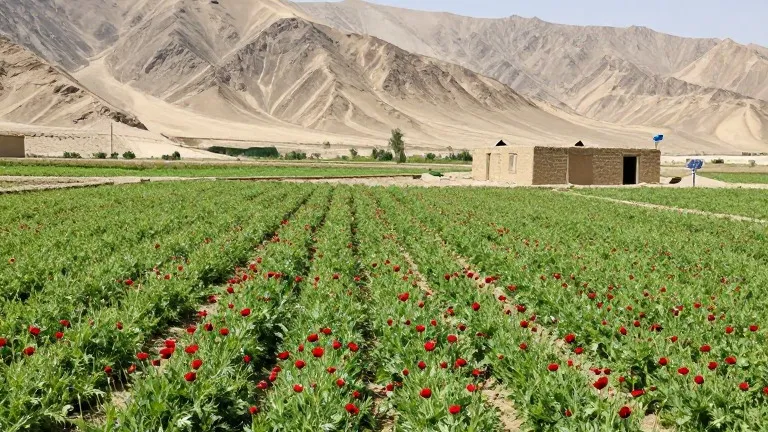
Since the Taliban imposed a ban on illicit narcotics in 2022, production inside Afghanistan has dropped sharply. However, David Mansfield, a UK-based expert on the region’s drug industry, says cultivation has surged across the borders into Pakistan and Iran. He describes the tri-border area as a new global center for opium production. Satellite imagery from the British firm Alcis identifies more than 9,000 hectares of poppy fields in Pakistan’s Balochistan province alone. Most of this growth is concentrated in the districts of Loralai and Killa Abdullah.
Local officials and farmers confirm the shift. Abdul Qahar Wadan, a former National Assembly member, claims senior military officials and power brokers are backing the crops in exchange for commissions. Monawar Hussain, the chief administrative officer for Killa Abdullah, disputes this, stating that eradication campaigns reduced the fields. Yet, Mansfield points out that 2026 satellite images show no clear evidence of such destruction. A farmer in Killa Abdullah noted that growers often plant poppies on barren land just before inspections to create a visual record of enforcement, a practice known as token eradication.
The economic drivers are simple. Lala Jan Kakar, a resident of Killa Abdullah, explained that drought and flash floods have ruined traditional fruit farming. Poppy now offers a higher income and more stable demand. Afghan farmers from Kandahar and Helmand have crossed the border to lease land in Pakistan. They invest millions of rupees in solar-powered wells and share the profits with local landowners. Mansfield calls the doubling of cultivated land in 2026 a strong signal that production levels will rise further in 2027.
A similar trend is occurring in Iran’s Sistan-Baluchistan province. Afghan farmers work as tenants there, often using drip irrigation systems that suggest long-term investment. Iranian authorities have focused on the war against the United States and Israel since late February, leaving them with little capacity to destroy the 2026 crop. Mansfield notes that farmers are moving from mixed farming to large-scale poppy monoculture, dedicating entire plots to the crop.
Inside Afghanistan, the ban is also showing cracks. Cultivation in Badakhshan Province, which accounts for half the national output, remains widespread. Farmers in the southwest have nearly doubled their planted area since 2025, often hiding poppies inside wheat fields or behind walls. The Taliban recently issued a directive banning home searches for opium without a court order. Mansfield warns that farmers may interpret this as permission to expand, potentially leading to a dramatic rise in production by 2027.