Carney criticizes Russia's invasion of Ukraine during APEC summit
Prime Minister Mark Carney condemned Russia's war against Ukraine while Vladimir Putin was present at the Asia-Pacific Economic Cooperation summit in China.
By Amir Bennett ·
Prime Minister Mark Carney delivered a strong critique of Russia's ongoing conflict with Ukraine during the Asia-Pacific Economic Cooperation summit in China. The remarks were made while Russian President Vladimir Putin was physically present in the room for the leaders' speeches. This event marks the first time the two leaders have shared a space since Carney assumed the role of prime minister.
Although the primary focus of Carney's address was on boosting the Canadian economy and attracting investment from Asian partners, he addressed the geopolitical landscape in the final segment of his remarks. He highlighted that sustained prosperity requires a stable international environment. Carney noted that geopolitical crises, specifically Russia's illegal invasion of Ukraine, continue to have significant economic consequences across the Asia-Pacific region and beyond.
According to prepared remarks shared by the Prime Minister's Office, Carney stated that such wars underscore the need for reliable partners who respect international law and territorial integrity. He emphasized the importance of building resilience among like-minded countries in the face of these challenges.
Prior to his plenary speech, Carney addressed Putin's recent comments suggesting that sanctions on Russia are no longer effective. In a news conference, Carney responded by telling Putin to consult his financial institutions, oligarch friends, and hockey players. The prime minister argued that these groups would find that sanctions are very real, biting, and necessary due to the illegal and unjustified nature of the war.
Carney also drew a parallel to former Prime Minister Stephen Harper's 2014 interaction with Putin. Harper had famously told the Russian leader, 'I guess I'll shake your hand, but I only have one thing to say to you: you need to get out of Ukraine.' In response, Putin reportedly said, 'I'm not in Ukraine.' Carney expressed his willingness to be similarly blunt if given the opportunity to speak with Putin face to face.
The Russian president has largely avoided international summits featuring Ukraine's Western allies since the full-scale invasion began in 2022. However, he attended the APEC meeting in Shenzhen this year for a rare trilateral meeting with U.S. President Donald Trump and Chinese President Xi Jinping. Ukraine was a major topic of discussion during this gathering.
During their bilateral meeting, Trump greeted Putin by calling him a friend, a comment that drew criticism from some quarters. Trump described the visit as highly consequential on social media, though it remained unclear if substantial agreements were reached beyond a vague commitment to avoid nuclear war. Xi stated the meeting focused on promoting world peace, while Putin noted that the countries hold joint responsibility for maintaining international peace.
Later in the day, leaders from the Coalition of the Willing, a group of roughly 34 Western nations supporting Ukraine, met to discuss the outcomes of the Putin-Trump-Xi meeting. Carney was in transit back to Canada, so Defence Minister David McGuinty attended on his behalf. McGuinty reaffirmed Canada's support for international efforts, emphasizing that any peace agreement must preserve Ukraine's sovereignty and strengthen Euro-Atlantic security.
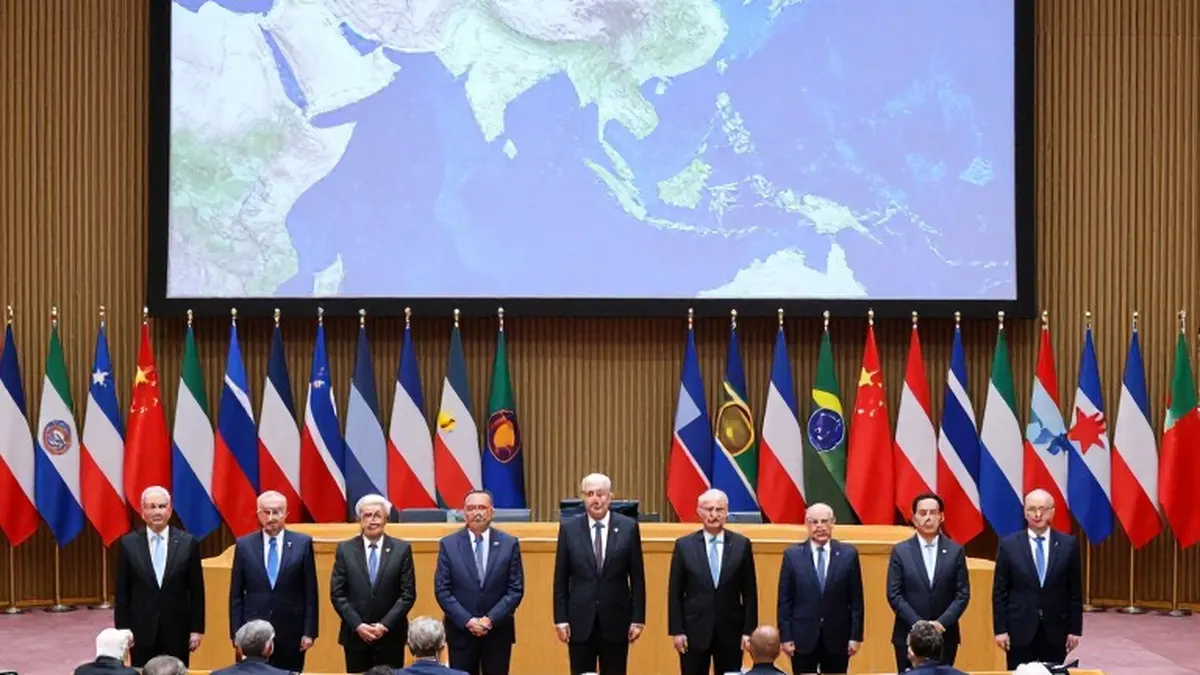
The Canadian position, as outlined in a readout from McGuinty's office, is that Ukraine must be fully involved in decisions regarding its own future. Carney later posed for the official leaders' family photo with Putin, who was seated two leaders over and one row down. It was not immediately apparent if the two engaged in conversation during the photo opportunity.
The Russian Embassy in Ottawa did not immediately respond to requests for comment regarding Carney's statements and the interactions at the summit. The event highlighted the complex diplomatic dynamics as world leaders navigate the ongoing conflict and its global implications.