Storm Boelo Winds Reach 75mph, Closing Major UK Sites
The second named storm of the season halted flights, grounded trains, and forced the closure of historic landmarks across northern Britain on Saturday.
By Carolina Barrett ·
Residents in northern Britain faced a disrupted weekend as Storm Boelo brought high winds and heavy rain to the region. The weather system, the second named storm of the season, caused travel delays and forced the closure of popular tourist attractions. Winds peaked at 75 mph in western Scotland before the full force of the storm arrived.
The Met Office issued amber warnings for parts of Scotland, Northern Ireland, and northern England. These alerts, the second most severe level, covered mainland Scotland and areas in England down to Carlisle. The warnings were active from 9 pm Saturday to 9 pm Sunday. A separate alert covered the north-east of Northern Ireland from 9 pm Saturday to 10 am Sunday. Broader yellow warnings extended into parts of North Wales and the rest of Northern Ireland.
Forecasters predicted widespread gusts between 60 and 70 mph across the affected zones. Exposed coastal locations faced the highest risk, with winds potentially reaching 80 mph. Before the peak of the storm, wind speeds of 75 mph were recorded at the South Uist Range in the Western Isles. Similar readings were logged in the Highland and Eilean Siar regions. The Met Office also issued yellow warnings for rain, noting that heavy downpours had already accumulated substantial rainfall totals.
Storm Boelo followed Storm Austen, which affected the UK on Friday. Gusts of 76 mph were measured at St Mary’s airport in the Isles of Scilly during the earlier system. Wind speeds of 74 mph were recorded at Aberporth in south-west Wales, while Culdrose in Cornwall saw gusts of 71 mph. Hundreds of homes in south-west England remained without power after the first storm. The National Grid reported that power had been restored to over 131,000 properties by 7 pm on Saturday.
Rainfall has been substantial since 8 am on Saturday. White Barrow in Wiltshire recorded 72 mm of rain. Cwm Dyli in North Wales and Inveruglas on the west shore of Loch Lomond in Scotland both recorded 43 mm. The Environment Agency issued 58 alerts for areas in England where flooding was possible by 8 pm on Saturday. An additional 12 warnings indicated that flooding was expected in specific locations.
Met Office chief forecaster Jason Kelly said the storm would be felt across the UK, with the strongest winds and greatest disruption occurring in the north. He advised the public to stay indoors to avoid flying debris and crashing waves. Kelly urged people to secure loose items outside and to plan ahead for travel. He also recommended monitoring the latest forecasts for updates.
Transport operations were heavily affected by the weather. Dublin airport canceled nine outbound and ten inbound flights as of 4 pm on Saturday. Six inbound flights performed go-arounds, with five landing on the second attempt. One flight diverted to another airport before returning to Dublin. Network Rail shared images of a trampoline and a shed near the tracks, prompting a call for residents to secure garden furniture firmly.
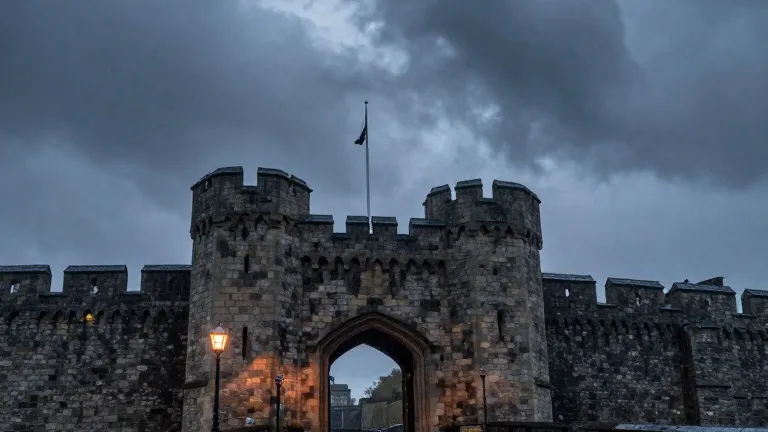
Public events and attractions canceled their schedules in response to the weather. Visit Liverpool announced that the region’s River of Light event had been cancelled for safety reasons. The annual Diwali on the Square celebrations in London were also called off following recommendations from independent health and safety experts. Edinburgh Castle and the Fountains Abbey estate in North Yorkshire closed on Sunday. Fountains Abbey had planned to host its Fountains by Floodlight event.