Six Arrested for Illegal Excavation at Ancient Judean Hills Site
Suspects caught by authorities while digging in an ancient cistern near Mevo Beitar, causing irreversible damage to a site spanning nearly a millennium.
By Youssef Carter ·
The Israel Antiquities Authority announced on Wednesday that six individuals have been arrested on suspicion of stealing antiquities and damaging a protected archaeological site. The suspects were apprehended by the IAA’s Theft Prevention Unit over the weekend while they were allegedly conducting unauthorized excavations at the Horvat Adash site, located in the Judean Hills near the town of Mevo Beitar.
Horvat Adash is a formally declared archaeological zone containing the remnants of a settlement that thrived for approximately 1,000 years. The site spans a significant historical range, from the First Temple period in the 1st century BCE to the Early Muslim period in the 8th century CE. Previous archaeological work has uncovered a variety of structures, including a public purification bath with a double entrance, residential ruins, industrial installations, water systems, and a public building from the Early Muslim era that functioned as a mosque.
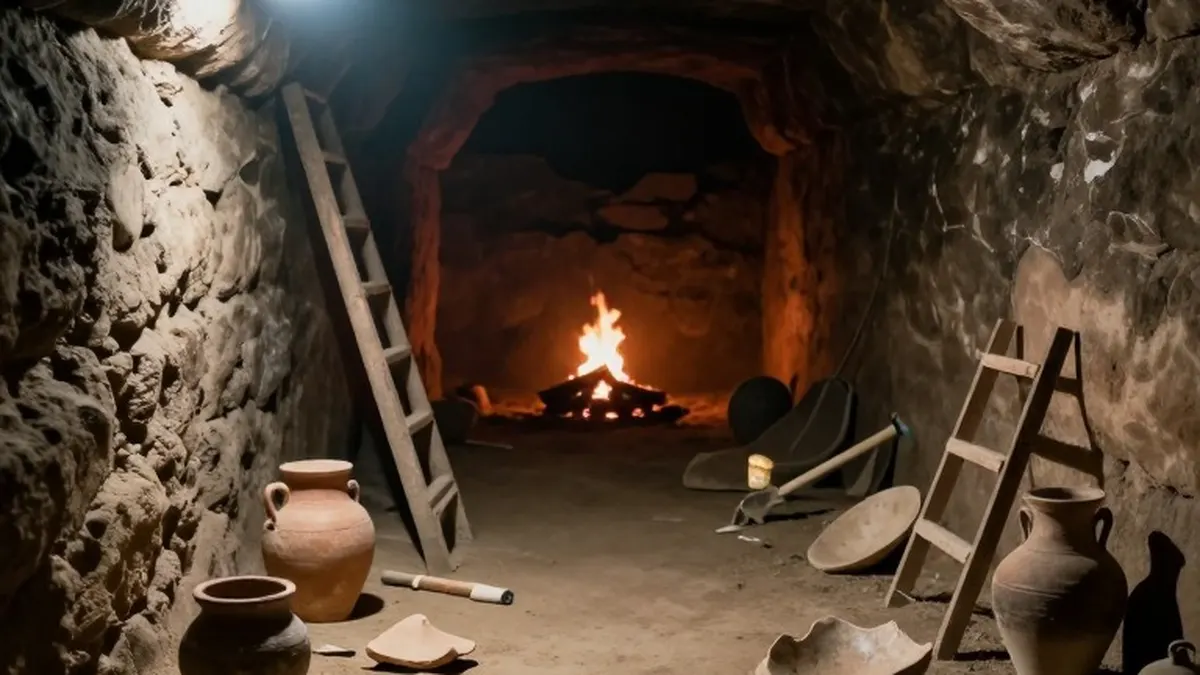
Upon their arrival, the group was equipped with substantial excavation tools designed for heavy work. Their gear included a generator, an electric jackhammer, augers, standard digging implements, a long ladder, and lighting equipment. Authorities observed that while some members of the group were digging nine meters below the surface inside an ancient cistern, others remained on the ground nearby around a lit campfire. Investigators believe the campfire was used to disguise the activity as a casual picnic.
The excavation yielded numerous ancient artifacts from within the cistern. Recovered items included fragments of hundreds of pottery vessels, several stone containers, and a specific fragment of a zoomorphic vessel. This particular artifact, which features a neck shaped like an animal, dates back to the Early Muslim period. The wide variety of finds from different historical periods led researchers to conclude that the cistern had likely ceased its original function in antiquity and was subsequently used as a refuse pit.
The unauthorized digging caused irreversible harm to the archaeological site. Inside the cistern, the walls and floor were damaged, cracking ancient plaster layers that had remained preserved in place for centuries. Extensive signs of destruction were evident in the area where the suspects broke into the structure. The IAA believes the group was searching for a hidden treasure, a common motivation for such illicit operations.
Dr. Amir Ganor, director of the IAA’s Antiquities Theft Prevention Unit, noted that social media legends about hidden treasures have recently grown in popularity. These narratives encourage individuals to dig without permits in hopes of quick wealth. Ganor explained that the reality is often harsher, as illegal excavations destroy ancient layers and disconnect findings from their archaeological context. This process causes valuable historical information to be lost permanently, which cannot be restored once the site is disturbed.
Ganor emphasized that treasure hunting is a serious criminal offense that can lead to investigation, prosecution, heavy fines, and imprisonment. He stated that the damage inflicted on these sites is a loss for the heritage and history that belong to everyone. The six suspects were taken to a police station and interrogated. They face charges of damaging an antiquities site, a crime carrying a statutory penalty of up to five years in prison. The case will be transferred to the prosecutor’s office once the investigation is complete.
Heritage Minister Amichai Eliyahu also commented on the incident, stating that the ancient sites of the Land of Israel are not a free-for-all. He declared that authorities will not allow these locations to become playgrounds for treasure hunters at the expense of the shared public heritage. Eliyahu affirmed that those who destroy history will be brought to justice, and the ministry will continue to fight looting to preserve the region’s cultural assets for future generations.